US FDA REGISTEREDFSSAI LICENSEDCDB RECOGNISED EXPORTERNABL THIRD-PARTY TESTEDMALTODEXTRIN-FREEHIGH POTASSIUMLOW SODIUMUS FDA REGISTEREDFSSAI LICENSEDCDB RECOGNISED EXPORTERNABL THIRD-PARTY TESTEDMALTODEXTRIN-FREEHIGH POTASSIUMLOW SODIUM

Our
process

LOW HEAT. CLEAN CARRIER. VERIFIED AT EVERY STAGE.

Our manufacturing process is built around three principles: protect the natural electrolyte profile, keep the ingredient declaration clean, and document everything for international buyer verification.

STEP 1

Sourcing

Tender coconuts from Indian coastal belts

We source tender coconuts from established coconut-growing regions of India. Coconuts are selected for maturity, water content, and natural electrolyte profile. Each batch is tagged for traceability back to source.

STEP 2

Extraction & filtration

Filtered within hours of harvest

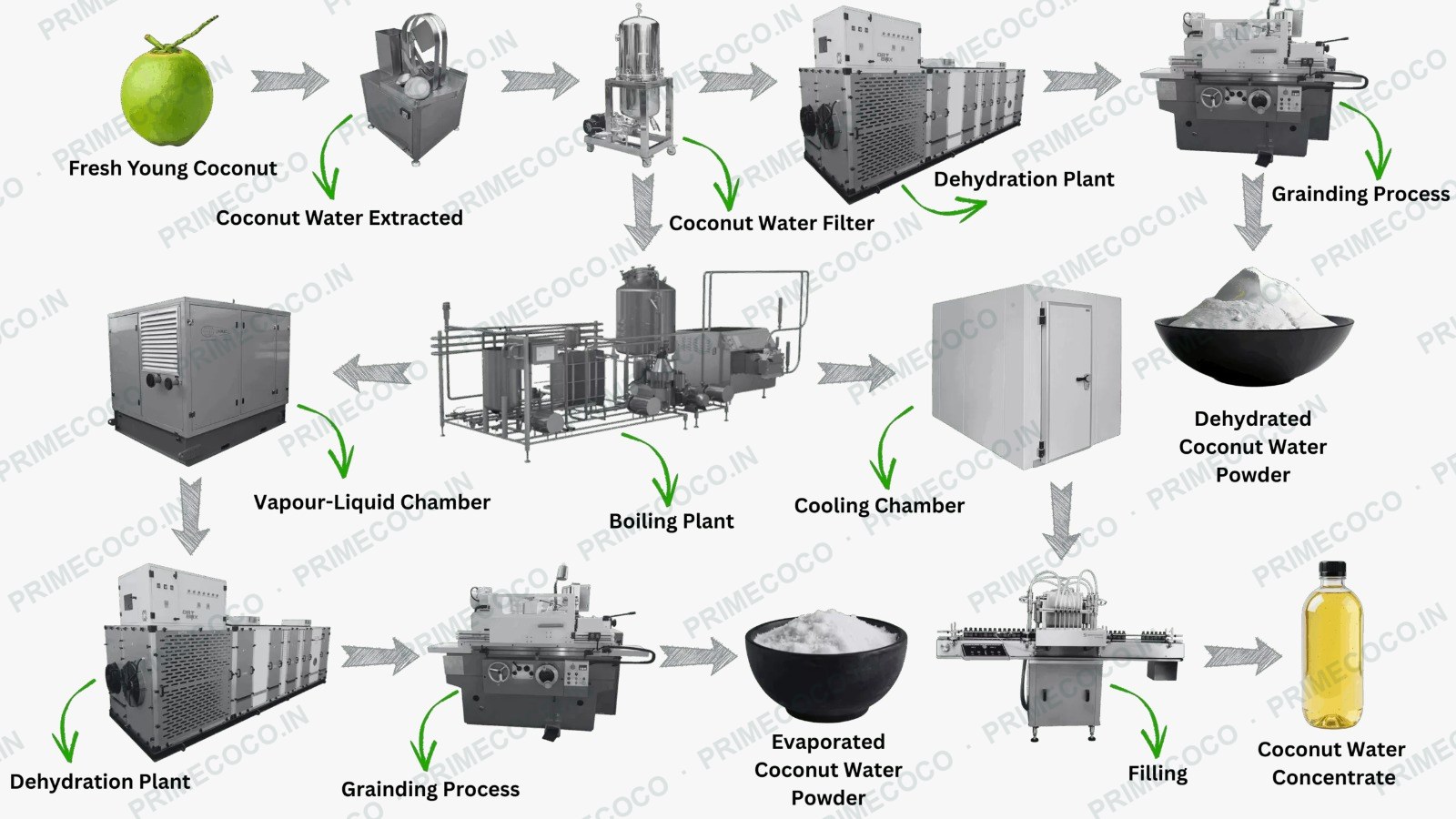
Coconut water is extracted from fresh tender coconuts within hours of harvest, filtered through a multi-stage filtration system to remove fibres and shell fragments, and held in temperature-controlled tanks pending processing. Speed of extraction preserves the natural electrolyte profile and flavour.

Gentle pasteurization

Filtered coconut water is gently pasteurized — heated at controlled temperatures to eliminate harmful microorganisms while preserving natural flavour and nutrients — before it moves on to concentration or dehydration.

STEPS 3 & 4

Two paths,
one source

Coconut water concentrate and powder manufacturing process flow — from fresh young coconut through extraction, filtration, dehydration, vacuum evaporation, cooling and filling to finished concentrate and powder

CONCENTRATE PATH

Low-heat evaporation

Filtered coconut water is reduced using low-temperature evaporation. This protects heat-sensitive compounds — natural Vitamin C, polyphenols, delicate flavour notes — that high-heat processing would destroy. Concentrate Brix is tuned to customer specification, anywhere from 60° to 82°.

POWDER PATH

Maltodextrin-free dehydration

Coconut water (or coconut water concentrate) is dehydrated. We do not use maltodextrin. Dehydration parameters are tuned to a lower-than-industry-standard inlet temperature to protect flavour and electrolytes. The result: 30,000–45,000 mg/kg potassium retained in the finished powder, with sodium staying naturally low (NABL-verified).

Cooling & sterilization

After concentration or dehydration, rapid cooling stabilises the output and a sterilization step keeps it free of microbes. This is what makes both the concentrate and the powder safe for global distribution, ahead of the quality verification below.

THE EQUIPMENT

Machinery behind
every batch

Coconut water extractors

Specialised machines that remove water from tender coconuts cleanly, without contamination.

Filtration units

Multi-layer filters that strip fibres, shell fragments, and other impurities for clarity.

Pasteurizers

Gentle heat-treatment systems that protect natural taste and nutrients while ensuring hygiene.

Vacuum evaporators

The core equipment for the concentrate path — reduce the liquid at low temperature and pressure to raise Brix without high-heat damage.

Cooling systems

Rapid cooling chambers that stabilise the concentrate immediately after evaporation.

Spray / freeze dryers

Convert coconut water or concentrate into powder form for extended shelf life and wider applications.

Automated filling machines

Sterile, precise filling into bottles, drums, aseptic bags, or IBC totes for export.

STEP 5

Third-party
quality verification

NABL-accredited testing

Every batch is tested at NABL-accredited laboratories: Lilaba Analytical Laboratories (TC-7179) and Assure Analytical Laboratories, both in Surat. Independent verification of metal contaminants, pesticide residues, nutritional composition, and microbiology.

What we test for

Heavy metals (Arsenic, Cadmium, Copper, Tin, Zinc — all below FSSR 2011 limits). Pesticide residues (29 commonly-tested pesticides — all BLQ in our most recent batch). Nutritional composition (potassium, sodium, sugars, vitamins). Microbiology per FSSR 2011.

STEP 6

Aseptic
packaging

Powder packaging

Food-grade aluminium foil bags (25 kg), drums, retail sachets, or custom formats per buyer specification. 24-month shelf life under standard storage conditions.

Concentrate packaging

Aseptic bag-in-box, sterilised drums, or IBC totes depending on destination and storage requirements. Temperature: +4°C to −18°C cold-chain. 12-month shelf life.

STEP 7

Export
documentation

What ships with every order

COA, MSDS, packing list, certificate of origin, and any destination-specific compliance documents (FSVP package for USA, etc.). We coordinate freight from Mundra, Nhava Sheva, or air-freight via Ahmedabad (first priority) or Mumbai.

PROCESS FAQS

Concentrate &
powder, answered

How is coconut water concentrate made?

By extracting fresh tender coconut water, filtering and pasteurizing it, then concentrating it under vacuum evaporation before cooling, sterilizing, and packaging.

What is the difference between coconut water and coconut water concentrate?

Regular coconut water has high water content and a short shelf life. Concentrate has reduced water content, a longer shelf life, and is far easier to transport globally.

Can coconut water concentrate be converted into powder?

Yes. Through spray drying or freeze drying, concentrate can be turned into powder for easy storage and use across food and beverage applications.

Who uses coconut water concentrate?

Beverage manufacturers, food processors, health supplement brands, and distributors looking for a cost-effective, high-quality coconut ingredient.

READ THE FULL PROCESS GUIDE

Want to see
it firsthand?

Schedule a facility visit to our Olpad, Surat plant, or request a sample to evaluate the result of this process for yourself.